31. China/Guangxi: Mesmerizing views at Ruyi Peak (Ruyi Peak Scenic Area)
Hiking on Ruyi Peak
Today The Wandelgek had planned for a really full day of activities, but although he felt a lot better physically then before, it was not like he felt having a top condition yet. The plan was to firsrt go biking and rafting, but my guide had trouble booking that and asked whether I would mind visting Ruyi Peak first and go biking and rafting in the afternoon. I didn’t mind and in retrospect it was a perfect choice because after my visit and hike on Ruyi Peak I did not feel strong enough for the biking and rafting and I asked Tao whether those could be skipped definitely.
After breakfast, we left the resort and almost immediately bumped upon some road food stalls and I wondered about and asked Tao about the use of the bamboo.
Bamboo Cookers
Hollow bamboo tubes are used in Southeast China, especially in rural Guangdong and nearby Guangxi/Yunnan border areas, for a traditional cooking method called bamboo rice (竹筒饭, zhútǒng fàn). Cooks fill mature, hard bamboo sections with soaked glutinous rice mixed with meats, mushrooms, sausage, beans, or pumpkin, then steam or roast them over charcoal fire.
Cooking process
Freshly cut bamboo tubes (about 30–50 cm long) are split lengthwise, packed with ingredients and water, resealed with the other half or leaves/wire, and first steamed briefly (10–15 min) before finishing over open flames for smoky flavor. The bamboo traps moisture, infuses a subtle woody-earth aroma, and yields tender, non-greasy results without added oil.

Dishes and variations
- Rice with lap cheong sausage, ribs, or chicken/mushrooms—common at family eateries or markets.
- Sweet versions with coconut milk, sugar, and beans (similar to Thai khao lam but less caramelized).
- Marrow at the tube’s base becomes edible “soup” with the meal.
This primal technique highlights fresh, local ingredients and sustainability, as bamboo grows abundantly in southern China’s karst hills.

I think there were fresh coconuts on a small table next to the grill.
Bamboo baskets
It also reminded me of the small bamboo baskets I had seen in several Chinese restaurants and in one of my favorite hometown of Deventer restaurants as well, see:
These baskets are for steaming the food before it is put into the hollow bamboo for grilling.
Specific bamboo tube dishes from Guangzhou (Kanton)
- Bamboo rice (竹筒饭): Glutinous rice with lap cheong sausage, spare ribs, chicken, shiitake mushrooms, or pumpkin—signature at Ganzhu Nongzhuang in Conghua.
- Bamboo fish/chicken/bullfrog: Whole fish (e.g., grass carp), chicken chunks, or stin frog packed in tubes over charcoal; villagers supply bamboo daily.
- Steaming Dumplings with either vegetables or shrimps is a third dish.
In my Deventer restaurant named Jackies NYC (New York Cuisine), they use them to steam small pancakes in which additional vegetables, pieces of duck and sauce can be wrapped. A very good signature dish!!!

Market town of Gaotian
After this short intermezzo we drove to Ruyi peak past the rural market town village of Gaotian.
Yangshuo’s Hidden Rural Market Gem
Tucked in Gaotian Town, just downhill from Ruyi Peak, this lively rural market pulses with authentic Guangxi village life every few days (check local schedules; often Wed/Sun mornings). Stalls brim with fresh bamboo shoots, wild ferns, river fish, free-range chickens, and sticky rice for bamboo-tube cooking—plus handmade Zhuang brooms, chili pastes, and herbal teas. Vendors hawk seasonal karst bounty like pomelos, duck eggs, and smoked sausages amid chatter of water buffaloes and motorbikes; it’s the ideal pre-hike spot for picnic fixings or peeks into daily farm rhythms.
I began to notice Tao was loving to tell stories and info about rural life in this area of Guangxi, much more than about tge towns like Guilin and Yangshou and she was a real treasure trove of knowledge. I was luckybto have her as a travel guide because I had a lot more rural adventure planned.
The Ruyi Peak Cable Car
Next we entered the cable car to Ruyi Peak …

There was quite some area with fertile soil for agriculture and Tao explained she and her family were living in this area too and her husband was a farmer.
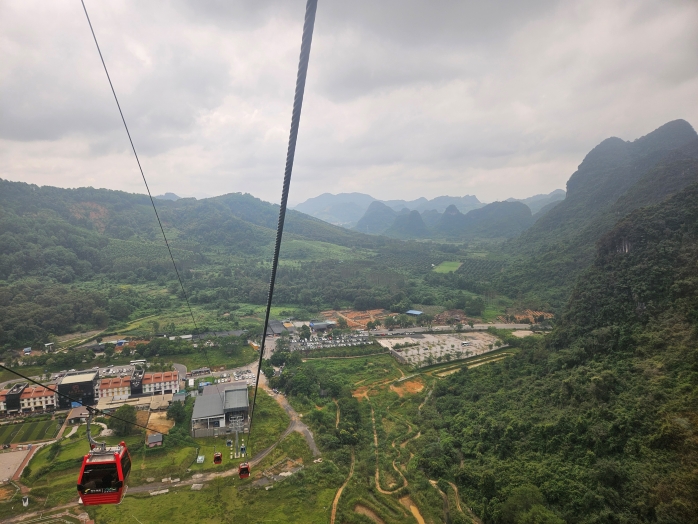
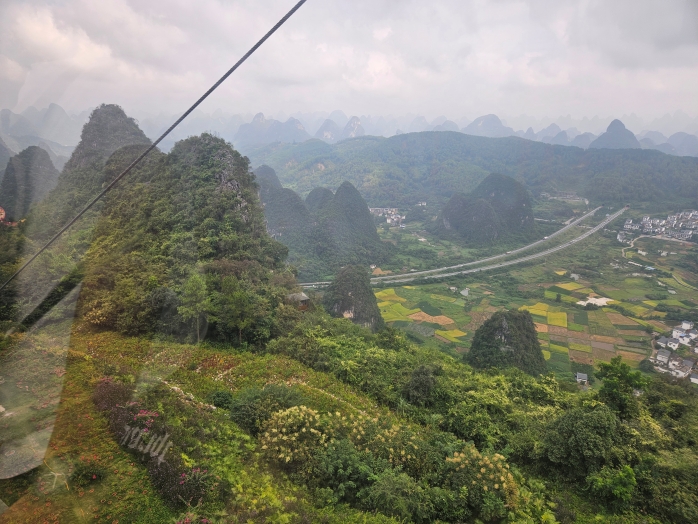


The Wandelgek’s Soaring Ride above Karst Hills on Ruyi Peak Cable Car!
Oh, what a joy it was for The Wandelgek to hop aboard the Ruyi Peak Cable Car, that magnificent 2012-meter aerial wonder spanning a heart-pumping 241-meter height difference! Gliding smoothly in the state-of-the-art French POMA gondola for just 10–15 minutes, I reveled in the sheer delight of 360° panoramas—layered karst peaks glowing in the light, lush valleys stretching endlessly, and the Li River’s silvery serpent weaving below.

Getting There from Yangshuo: The Wandelgek advises to grab a quick Didi ride (30–40 min, ~¥50) or a local bus from Yangshuo West Bus Station to Gaotian Town exit off G321. The scenic area entrance is steps away—open 8:30 AM–5:00 PM, tickets ¥208/adult (round-trip cable car included). I arrived at 9 AM to savor it crowd-free, comfy shoes on for the 3-hour trails with stairs.

The views were truely mesmerizing and everything The Wandelgek had hoped for upfront…

These Karst hills are so gorgeous and strange and other wordly that even George Lucas used them to envision and create the planet of Kashyyyk; the homeworld of the Wookies and of Chewbacca.
The above scenes are from the Star Wars movie: Revenge of the Sith.

Well, The Wandelgek was now maneuvering his X-Wing Fighter through the rocky Karst Hills of Kashyyyk, looking for a place to land …
The long Ruyi Cable Bridge

At the summit, crossing the swaying 142-meter Ruyi Cable Bridge sent tingles of excitement through me …
 The red ribbons with printed text on the suspension bridge (Ruyi Rope Bridge or Ruyi Cable Bridge) near Ruyi Peak in Gaotian are traditional Chinese prayer ribbons, often called Ruyi knots or wish ribbons (如意结, rúyì jié).

Purpose and tradition
Visitors purchase or bring these vibrant red ribbons, write personal wishes, prayers, or auspicious phrases on them (e.g., “good luck,” “health,” “prosperity,” family names, or dates), then tie them to the bridge’s railings or netting. This centuries-old custom sends hopes “to the heavens” via the high altitude, amplified by Ruyi Peak’s name meaning “wish granted.”

Visual details
- Appearance: Long (30–50 cm), narrow silk or satin strips in festive crimson, factory-printed with gold/blank space for custom messages. They flutter like a colorful “red ribbon” cloud (as seen from afar), contrasting the karst peaks.
- Location: Primarily along both sides of the 142-meter bridge deck, densest near the center and ends—thousands create a magical, windswept canopy.

Tourist ritual
Vendors at the summit or trailhead sell ribbon packs (¥10–20); tying one is a photo-op ritual blending thrill (58m valley drop) with spirituality. Faded ones stay year-round, layering multi-year wishes into a living tapestry.
Ruyi Peak
Next there were long winding stairs with many steps ascending from the bridge to the viewing platform on top …

A ruyi (Chinese: 如意; lit.: ‘as desired’, ‘as [you] wish’) is a Chinese curved decorative object that serves as either a ceremonial scepter in Chinese Buddhism or a talisman symbolizing power and good fortune in Chinese folklore. The “ruyi” image frequently appears as a motif in Asian art.

Pair of ruyi scepters.
Left: China, 18th century, Qianlong period, 1736–1795, Qing dynasty. Cloisonné on brass. Decorated with brass inlays incorporating the seal-script character for longevity, together with auspicious images of fish and bats—homophones for the Chinese characters for abundance (yu) and happiness (fu) respectively—this scepter would have been an ideal gift for a birthday or New Year celebration. Bequest of Miss Mary Lewis, 1909-37.
Right: China, 19th century, Qing dynasty. Jade (nephrite) with incised decoration. Incised on the back of this scepter’s handle is a poem composed by the Qianlong emperor (ruled 1736–95) that highlights his appreciation for objects such as this, which he considered indispensable for a learned gentleman. Gift of Mrs. George S. G. Cavendish, 1961-225-1.
Ruyi refers primarily to the Ruyi Jingu Bang, the iconic magical staff wielded by Sun Wukong, the Monkey King, from the classic Chinese novel Journey to the West. This weapon, often translated as the “Gold-Banded As-You-Will Cudgel” or “Compliant Golden-Hooped Rod,” originates as a massive iron pillar from the Dragon King’s underwater palace, used originally as a stabilizing pillar for the seas.
More about that can also be read in my previous blogpost where I visited the Dragon King’s Palace in the Yellow Dragon Cave in the Wulingyuan/Zhangjiajie area:
Sun Wukong acquires the Ruyi Jingu Bang early in his adventures when no other weapons suit his immense strength; it shrinks to fit behind his ear or grows to pillar-like proportions on command, weighing 13,500 catties (about 17,550 lbs or 8,100 kg). Its name “Ruyi” evokes a scepter of fulfillment in Chinese culture, symbolizing adaptability, while “Jingu Bang” highlights its golden hoops and bands, making it a perfect match for Wukong’s rebellious, transformative nature. In adaptations like games (Black Myth: Wukong) or fan stories, it sometimes gains darker traits, such as curses or self-awareness, amplifying Wukong’s chaotic power.
Circling the Yunding viewing platform offered postcard-perfect vistas of Yuanbao Peak, Necklace Peak, and infinite peak forests—

… every golden-hour snapshot a treasure for my wandering soul …

I look with mixed feelings at these photographs of me mountain walking, because I remember having great difficulty climbing and retrieving my breath after such an ascend. I didn’t yet know why yet and blamed the food poisening, but while writing this post I do know what really was to blame and what in the upcoming months was causing my physical condition to seriously deteriorate. I’m not gonna write to much about that, but in this blogpost I’m explaining what happened after my journey home again and how I got through that dark period:

I looked around and saw happy chinese people on top of Ruyi Peak. They were preparing celebrations for the Moon Festival ( also named the Mooncake Festival and the Mid Autumn Festival).
Moon Festival
Tao explained that this harvest celebration falls on the 15th day of the 8th lunar month, when the moon is fullest, typically in September or October. Families gather to eat mooncakes—round pastries symbolizing reunion and completeness—while admiring the moon, lighting lanterns, and sharing stories.

Mooncake Significance: Filled with lotus seed paste, red bean, or salted egg yolk, mooncakes represent unity due to their circular shape mirroring the full moon. Historically tied to legends like Chang’e the moon goddess, they’ve been a festival staple since the Tang Dynasty, even used in rebellions to smuggle messages.
I did try a mooncake received as a present, which was yummy 🙂

Beneath is a map of the Ruyi Peak hiking trails. My walk was going left from the cable car station to the suspension bridge, crossing that and ascending to the Ruyi peak viewing platform. Next I descended via the other path, next turning left toward the bend bridge and next returning to the cable car station via the glass walk ways along the steep cliffs…

First The Wandelgek crossed the suspension bridge again …

The bended walkway
Walking further The Wandelgek saw this huge red, bended or bowed bridge, which led toward an area in the karst hills where tgere was a very steep cliff …

Above the view reaches between karst hills and over green agicultural land in the valley around Gaotian, which is visible too …

The views overhere were marvellous. Lots of the karst hills were overgrown by trees because of the relatively mild climate here …

A bit further down was a viewing platform which belonged to a service area with wash rooms and toilets, but we were not gonna walk overthere …

The beautiful Karst hills were everywhere …

This trail had been a really good choice. It actually had gotten to the point where The Wandelgek had decided hevwanted to stay longer at Ruyi peak and skip the biking and rafting defintely. He didn’t feel he was up to thatcand he felt he needed more time to finish this beautiful walking circuit …

O those views:


Then he got closer to the beginning of tge red bended bridge. The views of the bridge were very impressive too. How did they ever build this???


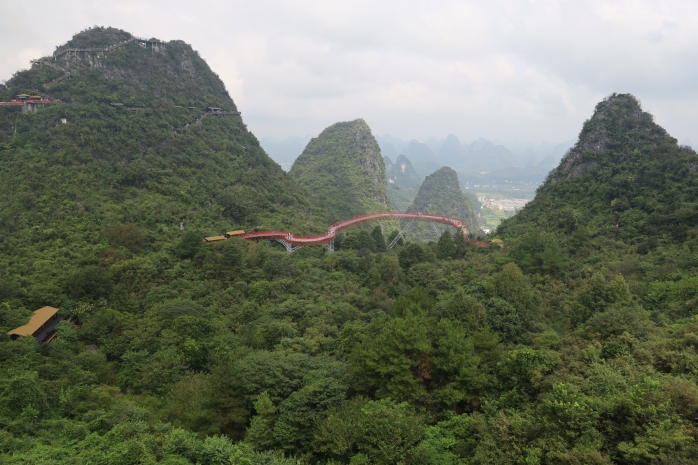


He walked on toward the red bended bridge, enjoying the views …

… and then walking across, he got immersed by the green vegetation beneath him …

The bridge was beautifully constructed and because of its bright red color, very visible in this green jungle …

Part of the bridge was constructed as a glass walk bridge…

After crossing there was a short walk toward a very, very, I can’t express this enough, very steep and high cliff.
Glass walkways
The glass walkway delivered an exhilarating rush. Standing at the edge of the glass walkway suspended along the sheer cliff face near Ruyi Peak, my heart pounds like a war drum as the wind howls through the jagged karsts of this abyss in south-east China. The transparent floor reveals a vertigo-inducing drop of over 1,000 meters straight down to misty ravines far below, where ancient pines cling impossibly to the rock like defiant fingers; each step sends a thrilling shiver up my spine, the glass creaking faintly under my boots as if protesting the audacity of human feet defying gravity.

Sweat beads on my brow despite the cool mountain air, adrenaline surging as I inch forward, gripping the slick metal railings—my eyes torn between the breathtaking panorama of mist-shrouded peaks piercing the sky, Ruyi Peak’s elegant curves looming like a jade scepter, and the terrifying void beneath, where one misstep would mean a freefall into oblivion. The Wandelgek in me revels in this raw pulse of the wild, halfway across when a sudden gust buffets the bridge, rattling the panels and blurring the chasm into a swirling haze; I laugh wildly, a mix of terror and euphoria, feeling utterly alive while chinese sparrowhawks wheel in circles below me.

This exhilarating dance with death etches itself into my wanderer’s soul forever, The Wandelgek pressing on with boots trembling yet resolute, the earth’s ancient breath rising through the glass to meet the heavens. One final stretch, railing in white-knuckled grasp, and I emerge victorious, chest heaving, transformed by the cliff’s unyielding whisper: The Wandelgek has conquered Ruyi Peak’s perilous embrace.

To cross these glass walkways without damaging them or making them filthy, it is neccesary to wear shoe covers of cloth over your own shoes. These are provided to you at the start of the glass walk …
There were safety nets hanging beneath the glass plates.

The views overhere were even more impressive, standing on see through glass plates above …. nothing but air …

There were train tunnels and tracks an large roads running through the karst hills. Those must have been impressive achievements to realize …

Overhere you could see how quick and how far Chona had come developing into a technical, architectural and economical world power …

Okay, one last view of the glass plates walk …

Return to the Ruyi Peak Cable Car
After this it was time to slowly walk back to the cable car station and start the descend toward Gaotian. Again you could see how fertile these valleys were.

Higher up there were whole forests of trees though …

The descend was quite breathtaking, specially when realizing yourself that the cable car you’re photographing, while it ascends the mountain, is very similar to the same as the one you are in, hanging hundreds of meters above the earth attached to a single metal wire …

After reaching the bottom cable car station, The Wandelgek returned by taxi to the Moondance Boutique Resort in Fenglou. He felt he needed rest to recuperate from the intensive walk and to enjoy writing in his journey diary.
It was also his last night at the resort, before travelling further for new adventures …