
An illustrated history of Interactive books Part 4: Modern era of pop up books and its important protagonists: Kubasta, Van der Meer, Pienkowsky, Carter and Gorey, by The Booknook Librarian
The word “pop‑up” arrives (the first 3D “box” worlds)
Early 20th‑century creators began pushing toward true three‑dimensionality: open the book, and a structure would rise by itself. It was S. Louis Giraud’s “Bookano Stories” in the 1930s that perfected what he called “living models”—scenes that stood upright when the book lay flat. These constructions often allowed the child to walk around the book on the table to see the diorama from multiple angles.

Bookanoo Stories -Potpourri Edition 1946
Bookano spreads are precursors of what later collectors call box pop‑ups or “stage” constructions: the opened spread forms a kind of shallow box or theater, with sidewalls and backdrops giving a framed 3D space. Later theatre‑style books—like pop‑up adaptations of “Moby Dick,” “Brambley Hedge,” or “Winnie‑the‑Pooh” theater books—inherit this idea: the mechanics create a miniature proscenium stage that you can peer into, sometimes even rearranging characters in the “box.”
EXAMPLES from:

In the United States, a marketing insight changed everything. Blue Ribbon Books started releasing titles with bold text on the cover: “A Pop‑Up Book.” The term was catchy and descriptive; books no longer just moved, they popped. This label stuck so strongly that the whole genre eventually adopted it.
These early pop‑up titles tended to feature centerfold scenes that sprang up thanks to carefully placed folds and glue. Bright color printing, designed to shout from bookshop windows. Recognizable characters like Pinocchio, enticing parents with a mix of familiarity and novelty.
Once the term “pop‑up” caught on, publishers had a convenient way to sell the concept: this was not just a picture book, this was a little paper machine that performed on command.
War, decline and rediscovery (Kubašta’s paper stages and carousel DNA)
World War II, paper rationing, and economic worries took a toll on elaborate children’s books. Movable and pop‑up titles did not vanish, but they became rarer and simpler. In the 1940s, American artist Julian Wehr kept the mechanical spirit alive with animated picture books whose characters moved when tabs were pulled, but the era of extravagant constructions was on pause.
Vojtec Kubasta (1914–1992)
Vojtěch Kubašta was a Czech architect and pioneering pop-up artist known for his intricate 3D fairy tale books.
In the 1950s and 1960s, a surprising source reignited ambition: Czechoslovakia. The illustrator and paper engineer Vojtěch Kubašta created fairy‑tale pop‑ups that folded out into richly layered stages, with cottages, forests, bridges and castles appearing in deep perspective.
EXAMPLE from:

His scenes often read like miniature theater sets: the foreground characters lean toward you, mid‑ground scenery creates depth, and background castles crown the horizon in a single explosion of color when the covers open.
EXAMPLE from:

Kubašta’s innovations include:
- Clever use of angled supports that allow wide, panoramic scenes from relatively small bindings.
- Very bold, graphic illustration styles that remain readable despite complex folding.
- Ingenious collapsing structures that can refold reliably, even after enthusiastic handling.
EXAMPLE from:

Structurally, many Kubašta spreads sit between box pop‑ups and dioramas: they open into deep, multi‑plane scenes that can stand on their own as displays, echoing the 19th‑century peep‑shows but with more drama and color. Exported widely through Artia and other imprints, Kubašta’s books proved that sophisticated pop‑ups could succeed as an international business even under constrained economic conditions, and they inspired many Western paper engineers who encountered them as children.
EXAMPLE from:

Very important for the popularization of the genre were the many delightful fairy tale stories which were made into pop up books by Kubasta. Their popularity grew so much that many translations were made and the books spread over Europe.
EXAMPLE from:

Meanwhile, American entrepreneur Waldo Hunt saw the potential in bringing complex pop‑ups back to the English‑language market. Through packaging firms and partnerships with major publishers, he coordinated teams of illustrators and paper engineers, turning pop‑up production into a manageable industry again rather than a risky one‑off craft. A new generation of engineers (many trained in design or architecture) began thinking of themselves as “paper engineers” in a serious sense.
Pop‑ups go big and educational (van der Meer, 70s parallel folds and big boxes)
By the 1970s and 1980s, the pop‑up book was ready to grow up alongside its readers. Titles appeared that combined large formats and complex structures with educational content: anatomy, geography, natural history, children’s education. The idea was no longer just “here is a castle that pops up,” but “here is the human heart, popping up to teach you how blood flows.”
In this period you also see characteristic 1970s‑style parallel‑fold constructions: repeated, accordion‑like fold systems where whole landscapes or structures open in staggered layers. Edward Gorey (who’ll I’ll write about in this blogpost made his Tunnel Calamity book in that style). Remember that this was not anything new, but a revived technique after the decline of pop up books during WWII. In my previous blogpost I wrote about the older 19th century versions of this style:
Open such a spread and a row of mountains, buildings or seating tiers rises in a clear stepped pattern—mechanically simple but visually impressive.
Ron van der Meer (born c. 1945, still active)
Ron van der Meer is a British paper engineer and pop-up designer behind interactive books like The Art Pack and Muppet pop-ups.
EXAMPLE from:

Dutch‑born paper engineer Ron van der Meer became one of the key figures of this phase. His books often unfolded into huge, almost architectural constructions: pop‑up stadiums, cities, landscapes and anatomical boards. Many of these use elaborated parallel‑fold and multi‑box structures—multiple rectangular “rooms” or terraces that rise in sequence. Van der Meer’s work showed that a book could function like a foldable exhibition—something you could put in the middle of a classroom table and walk around.
EXAMPLE from:

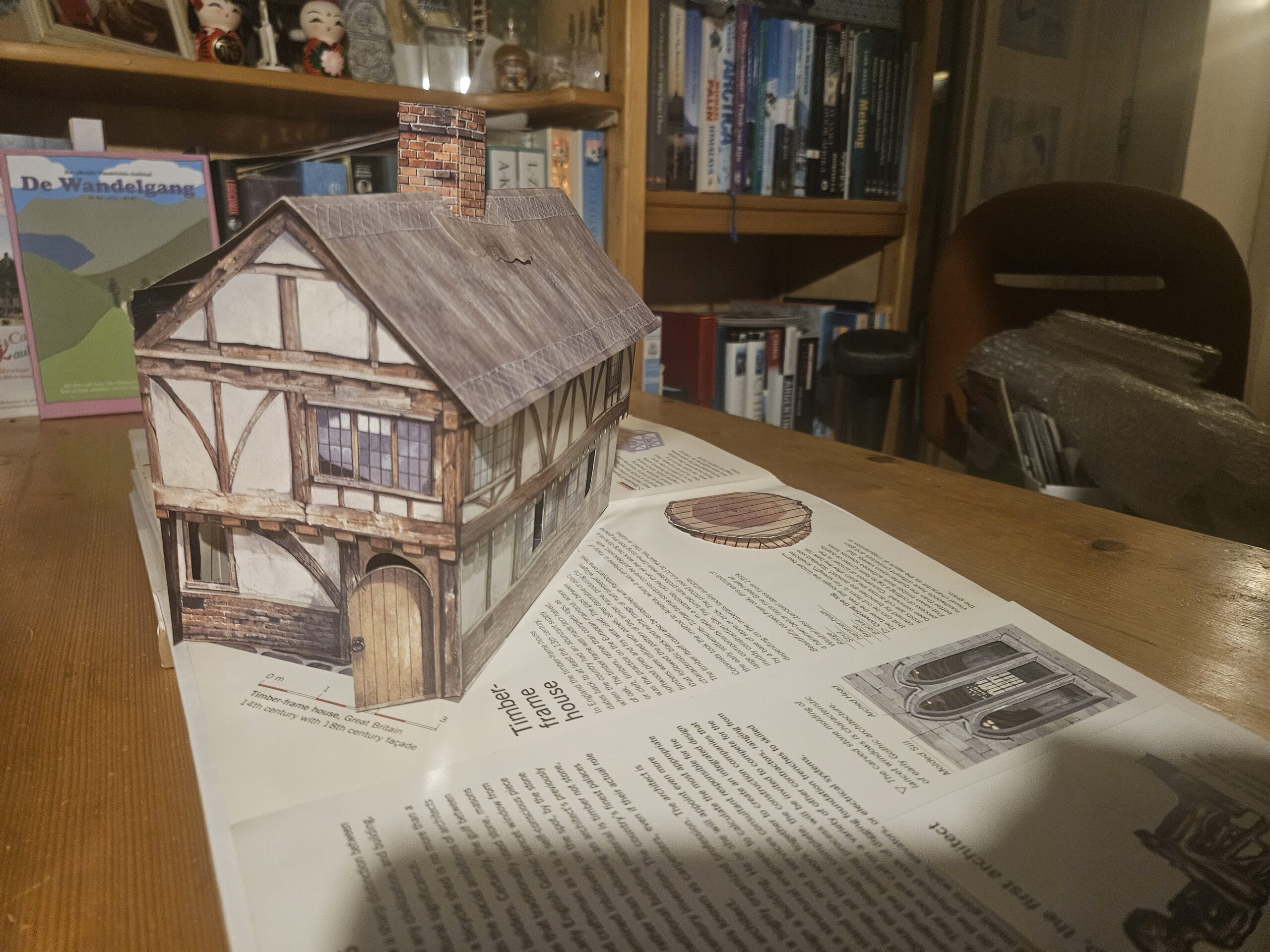
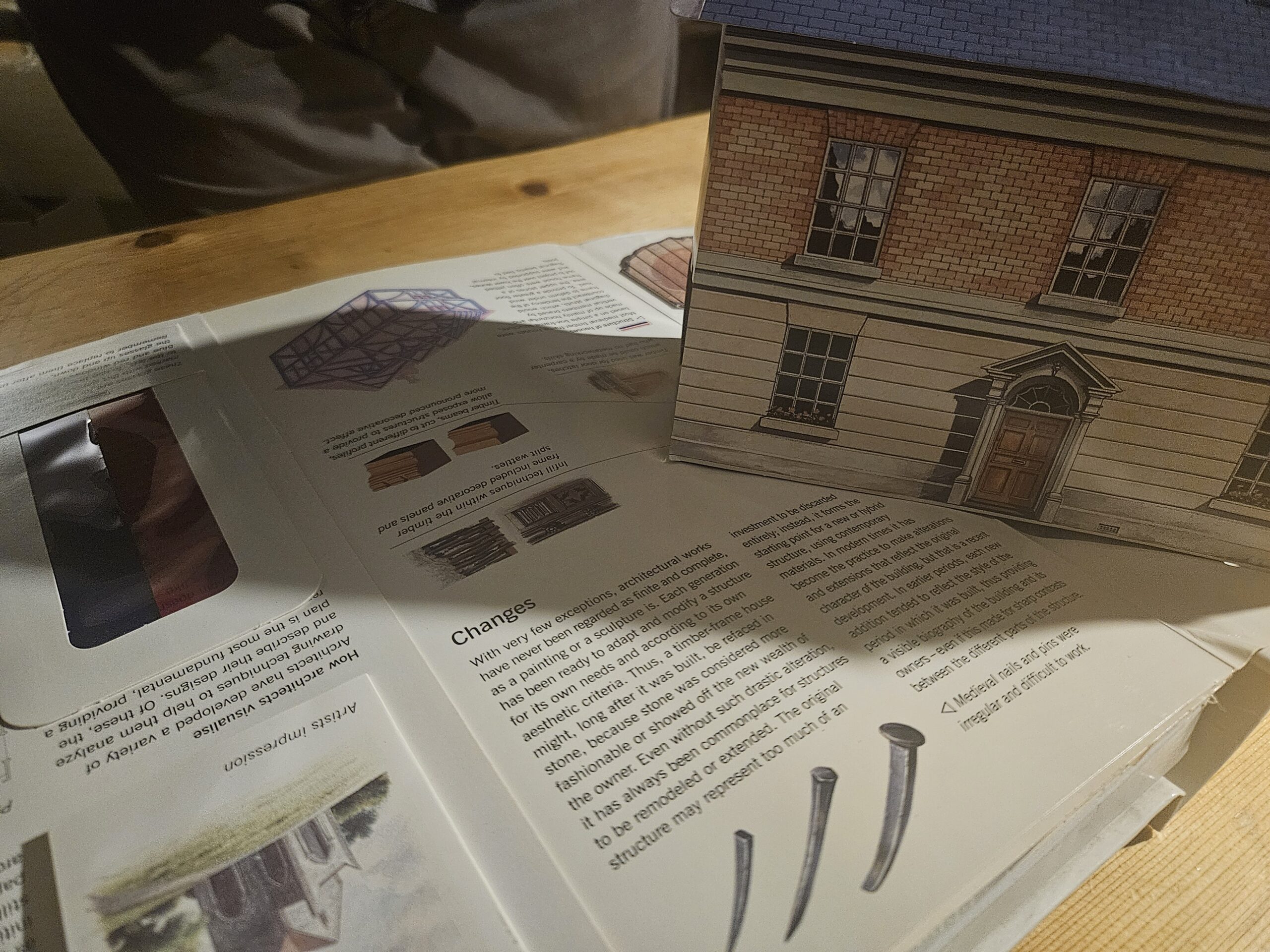


These books introduced several important trends:
- Giant central constructions that took up almost the entire double‑page spread or even extended beyond it.
- Multiple smaller flaps, mini‑pop‑ups, and pull‑tabs surrounding the main model, each explaining a concept.
- More robust materials and glues, because a pop‑up of the human brain or a stadium full of spectators had to survive repeated demonstrations.
The same era also saw more elaborate box‑theatre pop‑ups for stories—like “Winnie‑the‑Pooh” theatre books or Brambly Hedge‑style spreads where cottages open into doll‑house‑like interiors.
EXAMPLES from:
AND

Here, the “box” mechanism is used not just for a single tableau but for narrative spaces you can inhabit visually, almost like a fold‑out stage set for toy actors.
As parents and schools looked for ways to make science less intimidating and more tactile, the pop‑up format suddenly felt educational rather than frivolous. Paper engineers like van der Meer became quiet co‑authors of countless children’s encounters with biology, sports, architecture and technology.
Jan Pienkowski (1936–2022)
Jan Pienkowski was a Polish-British illustrator of Meg and Mog pop-up books and over 140 children’s titles.
Around the same time, Jan Pieńkowski added gothic humor to the mix. His 1979 book “Haunted House” (with engineering collaborators) wrapped sophisticated pop‑ups in a spooky, cartoon‑horror setting.
EXAMPLES from:

Opening a door might reveal googly‑eyed monsters, a bat on a spring, or a comically disgusting kitchen. The engineering itself was tight and varied—flaps, layers and pop‑ups integrated in one dense experience—but what many readers remember is how gleefully silly and slightly scary the whole thing felt. Pieńkowski proved that pop‑ups could be unapologetically playful, even anarchic, while still demonstrating high‑level paper design.
Another later work of brilliance by Pienkowsky was “Botticelli’s Bed and Breakfast“. It was a silly Bed and Breakfast run by David and Venus and full with art some hidden, some in plain sight. A “Do you see them all?”-Puzzle.
EXAMPLE from:

Display/Carousel and Diorama pop up books
This type of pop up book that had to be revived after the decline during WWII, were the display, carousel and diorama books. Lothar Meggendorfer started the first period in which they were popular with his diorama like Das Puppenhaus, which I showed in this blogpost:
The difference between a display and a carousel is that you cannot walk around a display. A display is directed toward one direction. A carousel is a 360° display and a diorama is not circular like a carousel, but more like an elipse. They all have lots of similarities though and are one category style of pop up books.
Here are some great examples:
EXAMPLES from:

Het Speelgoed Paradijs by Julius Siegmund (1985)
A Biedermeier style hause of a toy maker. Upstairs are the living room and kitche, downstairs are the workshop and the shop …
I’ve added an extra detailed movie with examples showing how much further this style has been perfected. In Lothar Meggendorfer’s Puppenhaus, it was sometimes quite difficult to make all the mechanics to “build” the Haus stay in position. In this more recent dolls house, the designer placed slots and used tabs fitting in those slots to keep stuff in position. Also certain cabinets are build like tiny boxes where the lid keeps them in the right shape …
AND

Victorian Market Day by Maggie Bateson & Herman Lelie (1994)
The addition of little people, market stalls and even a cabinet for a puppet show are interesting. This book is also interesting because it can be set up as a display as well as as a caroussel …
AND

The Secret Garden by Tom Patridge (based on the novel by Frances Hodgson Burnett) (1992)
This is a caroussel pop up book with figurines included …
AND

A THREE-Dimensional Victorian Dolls House (1998) by Willabel L. Tong and Renee Jablow
Again a doll house with several figurines and props included. Again a real caroussel pop up book …
Manuals, mechanisms and the craft behind the magic (Carter, Gorey and codified types)
A significant change in the late 20th century was that the secrets of pop‑up construction began to be openly documented. The magicians were explaining their tricks. Previously, mechanisms were closely guarded trade knowledge, passed from workshop to workshop like stage illusions. Now, step‑by‑step manuals explained how to fold a V‑shaped support, how to calculate angles so a tower stands straight, and how to layer multiple moving parts without everything jamming.
David A. Carter (born 1957, active)
David A. Carter is an American pop-up artist famous for the Bugs series and 600 Black Spots, with over 6 million copies sold.
David A. Carter emerged as both a prolific pop‑up creator and a kind of educator of paper engineers. His instructional and demonstration books on pop‑up mechanisms break down complex constructions into basic building blocks—V‑folds, parallel folds, box structures, pull‑tabs—often with spreads that show the mechanism nakedly and invite the reader to poke at it.
EXAMPLES from:

In parallel, his own pop‑up series like the “Bugs” books take minimalist, graphic illustrations and hide surprisingly complex mechanisms behind apparently simple shapes. Carter’s work teaches two lessons: that you can learn this craft systematically, and that you can do a lot with relatively few carefully chosen moves.
Edward Gorey (1925–2000)
Edward Gorey was an American illustrator whose gothic pop-up works like The Tunnel Calamity blended whimsy with macabre humor.
Although the title of this work is The Tunnel Calamity, the scene unfolding in the tunnel is strangely devoid of any sense of chaos or terror. A large furry animal with fearful eyes calmly roams the busy tunnel, yet no one sees him, apart from a diminutive child pausing to watch him walk by. Only the little boy has the ability to witness the ‘[u]nexpected appearance of the ULUUS (thought to have been extinct for over a century) in the tunnel connecting East Shoetree and West Radish. St Frumble’s Day, 1892’.
EXAMPLE from:

The Tunnel Calamity 1st edition 1984
At the more literary and macabre end of the spectrum, Edward Gorey flirted with movables and pop‑ups in a handful of projects and special editions. His characteristic cross‑hatched, deadpan style translates intriguingly into three dimensions: a doorway opening onto some ambiguous doom, a figure raised from a coffin, a landscape that folds into a stage for a very understated catastrophe. Gorey’s ventures into the format suggested that pop‑ups could be vehicles for adult, even morbid humor, not just bright nursery colors and smiling animals.
In his book: The Dwindling Party, he shows us a jolly party visiting a park at an estate. One by one all but one of the members dissappear, being eaten or abducted by all sorts of monsters, without anyone noticing.
EXAMPLES from:

Together, engineers like Carter and artists like Gorey broadened the perceived range of the medium: from craft instruction to visual poetry, from educational charts to dark comedy. They also helped establish the vocabulary and fix and name many of the types—parallel folds, box pop‑ups, V‑folds, carousel books—that collectors and makers now reference.
Just to show you how broad the diverse topics of pop up books had gotten, here some last examples:
EXAMPLES from:

AND

A classic English children’s book …
AND

A book to playfully help children count until 10 …
AND

A history of flying explained for children …
AND

A famous comic book …
AND

A pop up book showing us some samples of famous Russian Fabergè eggs. These were ordered by Russian Tsars and used as decorations and royal gifts …
The possibilities seem sheer endless and they were going to defy every rule and scale every obstacle in the 21st century.
But first we’ll go back to the development of interactive books in my next upcoming blogpost…